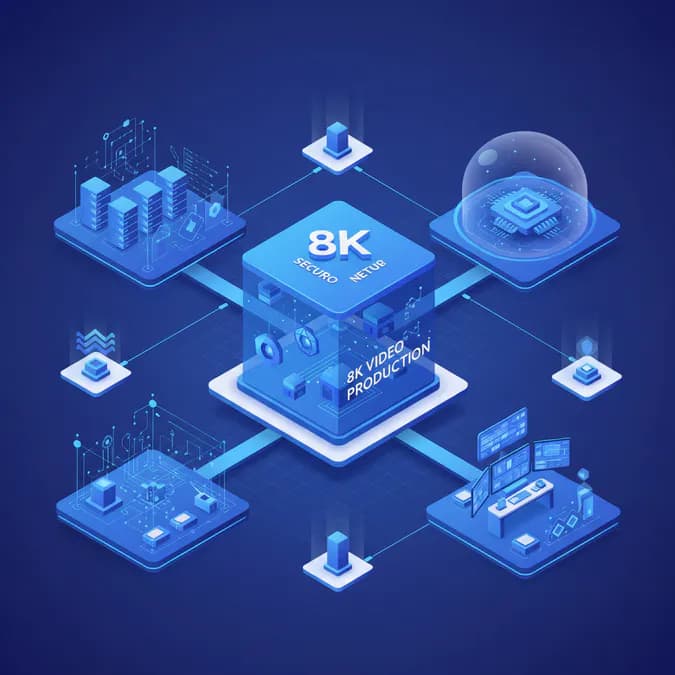
8K video production is reshaping professional video production in ways that extend far beyond consumer television screens. While 8K TVs remain a niche product in living rooms, cinematographers, live-event crews, and sports broadcasters have already embraced 8K as a powerful acquisition and mastering format. The technology's real value lies not in delivering 8K content to viewers, but in providing producers with unprecedented flexibility during capture, post-production, and archival.
With a resolution of 7680 × 4320 pixels—roughly 33.2 million pixels per frame—8K offers approximately four times the pixel density of 4K. This abundance of visual information enables editors and cinematographers to reframe shots, stabilize footage, and downconvert to cleaner 4K and HD outputs without sacrificing quality. For productions ranging from high-end television and cinema to live sports and events, 8K video production has become an essential tool for improving final deliverables, even when audiences never see the full 8K resolution.
However, this power comes with infrastructure demands. Professional 8K workflows require high-throughput storage systems, robust networking, and powerful editing hardware. Understanding how 8K is being deployed in production today reveals both the technology's transformative potential and the practical challenges producers must overcome.
The 8K Advantage: Why Producers Are Adopting the Format
8K's adoption in professional production stems from a fundamental principle: greater resolution provides greater creative control. As noted in research on the value of 8K video production, "Greater resolution means a better way of storytelling." This philosophy drives producers to capture at 8K even when final deliverables are 4K or HD.
The primary advan
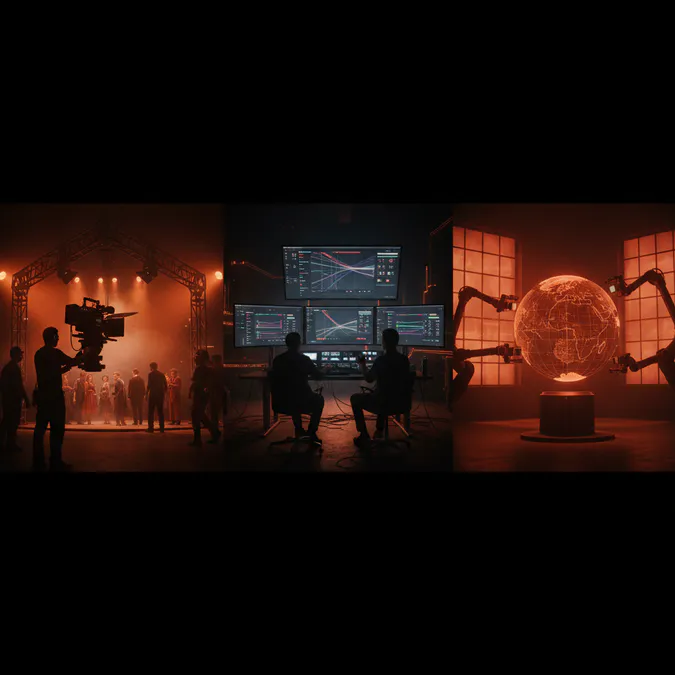
Stabilization is another critical benefit. 8K's pixel density allows editors to apply digital stabilization to shaky footage while maintaining sharp, clean output at 4K or HD resolution. In live-event coverage and documentary filmmaking, where perfect camera work isn't always possible, this capability significantly improves final quality.
Long-term mastering and archival represent a third major use case. By capturing and storing content at 8K, producers future-proof their work. As display technology evolves and higher resolutions become more common, archived 8K masters can be repurposed without re-shooting. This forward-looking approach protects production investments and ensures content remains relevant as viewing standards change.
8K Workflows: From Capture to Downsampling
Understanding 8K workflows requires recognizing that 8K is primarily an intermediate format in most professional pipelines. Producers capture at 8K, perform editing and color grading at that resolution, then downconvert to 4K or HD for distribution. This approach differs fundamentally from traditional workflows where content is captured at the final delivery resolution.
The downsampling process—converting 8K to 4K or HD—produces noticeably cleaner results than capturing at lower resolutions from the start. When you reduce 33.2 million pixels to 8.8 million (4K) or 2.1 million (HD), the mathematical averaging of pixel data creates smoother gradations, fewer artifacts, and superior detail preservation. This is why 8K video production is increasingly used to enhance the quality of HD and 4K workflows, even in productions where 8K distribution isn't feasible.
Visual Effects and Color Grading Benefits
Visual effects workflows benefit significantly from this approach. VFX artists working with 8K source material have more pixel information to work with, making compositing, keying, and motion tracking more precise. Complex effects that might show artifacts or quality loss at 4K can be executed cleanly at 8K and then downsampled for delivery.
Color grading also improves with 8K workflows. The additional pixel density provides more information for color correction algorithms, resulting in smoother color transitions and more accurate skin tones. Professional colorists increasingly prefer working in 8K even when final delivery is 4K, as the quality difference is immediately apparent.
Infrastructure Demands: The Hidden Challenge
While 8K's creative benefits are clear, the technology introduces significant infrastructure challenges. Professional 8K workflows demand storage and networking capabilities far beyond standard production environments.
Uncompressed 8K playback at 24 frames per second requires approximately 5 GB/s of storage throughput. As Greg Shiff, Senior Solutions Architect at Dell Technologies, explains in technical demonstrations: "You're not going to be able to get that from even a single NVMe drive. You need multiple." This means production facilities must invest in high-performance storage arrays, often combining multiple drives and advanced RAID configurations to achieve necessary throughput.
Networking infrastructure must also be upgraded. Traditional gigabit Ethernet is insufficient for 8K workflows. Professional facilities increasingly deploy 100GbE (100 gigabit Ethernet) networking to move large 8K files between storage, editing systems, and backup locations. This infrastructure investment represents a significant capital expense for production companies.
Editing System Requirements
Editing systems themselves require substantial upgrades. Real-time 8K editing demands powerful processors, high-capacity RAM, and GPU acceleration. Not all editing software supports native 8K timelines, requiring producers to work with proxy files or specialized applications. This adds complexity to post-production pipelines and extends project timelines.
Despite these challenges, the quality improvements justify the investment for high-end productions. Major television networks, film studios, and sports broadcasters have determined that 8K video production and mastering deliver sufficient quality gains to warrant the infrastructure costs.
8K in Television and Film Production
Television and film production have emerged as early adopters of 8K technology. Premium television series and theatrical films increasingly use 8K cameras for principal photography, particularly for scenes requiring extensive reframing or visual effects work.
In television, 8K acquisition enables producers to deliver sharper, more detailed 4K broadcasts. As streaming platforms and cable networks upgrade their distribution capabilities, 8K masters provide a quality advantage that differentiates premium content. The ability to reframe shots in post-production also reduces the need for reshoots, saving time and money on expensive productions.
Film production benefits similarly. Cinematographers using 8K cameras gain creative flexibility during shooting, knowing they can adjust framing and composition in the color suite. For films destined for theatrical release, 8K masters ensure the highest possible quality for DCP (Digital Cinema Package) creation and future re-releases on emerging formats.
Long-Term Archival and Re-Release Value
Archival value is particularly important in film. Studios maintain 8K masters of major productions, ensuring that classic films can be restored and re-released in higher resolutions as technology evolves. This long-term perspective on content value drives investment in 8K mastering even for films primarily distributed in 4K.
8K in Live Sports and Event Production
Live sports and event production represent some of the most demanding applications for 8K video production. Sports broadcasters use 8K cameras to capture games, matches, and competitions, then downconvert to 4K for broadcast distribution.
The reframing capability is particularly valuable in sports. A single 8K camera positioned to capture wide shots can be digitally cropped to follow individual players or focus on specific action. This reduces the number of cameras needed and provides editors with more flexibility in constructing compelling highlight reels and broadcast packages.
Stabilization is critical in live sports coverage. Handheld camera operators and remote camera systems can capture footage that might be slightly shaky, then apply digital stabilization in post-production while maintaining 4K quality. This improves the viewing experience without requiring perfect camera work during live events.
Event Production Applications
Event production—including concerts, conferences, and ceremonies—uses 8K similarly. The format provides insurance against framing mistakes and enables creative reframing during editing. For premium events where multiple camera angles are captured, 8K acquisition ensures consistent quality across all angles when downconverted to 4K or HD.
Consumer 8K Adoption: The Missing Piece
Despite 8K's growing use in professional production, consumer adoption remains limited. 8K televisions exist but represent a tiny fraction of the TV market. Streaming services have not widely adopted 8K distribution, and bandwidth limitations make 8K streaming impractical for most consumers.
This disconnect between professional adoption and consumer availability reflects the current state of 8K technology. The format's value in production is well-established, but the distribution infrastructure and consumer demand for 8K viewing have not yet materialized. Producers are investing in 8K capture and mastering as a long-term strategy, betting that consumer 8K adoption will eventually follow.
Market research projects strong growth for 8K technology through 2032, suggesting that industry confidence in the format's future remains high. As display technology improves and costs decline, consumer 8K adoption may eventually accelerate, validating the investments producers are making today.
The Future of 8K in Professional Production
8K video production is fundamentally changing how professional video is produced, even though most viewers will never see 8K content. The format has become essential for high-end television, film, sports, and event production—not as a delivery format, but as a production tool that improves quality, flexibility, and longevity.
As infrastructure costs decline and 8K workflows become more standardized, adoption will likely expand beyond premium productions to mid-tier television and streaming content. The combination of creative benefits and long-term archival value makes 8K an increasingly rational investment for producers seeking to maximize quality and future-proof their content.
The transformation is already underway. Cinematographers are capturing in 8K, editors are mastering in 8K, and broadcasters are storing 8K masters. The fact that audiences typically view 4K or HD outputs doesn't diminish the value of 8K acquisition and mastering. As one industry perspective notes, "Greater resolution means a better way of storytelling"—and that principle is driving 8K adoption across professional production today.
Key Takeaways
- 8K video production offers unparalleled resolution and flexibility for filmmakers.
- Infrastructure upgrades are essential for effective 8K workflows.
- 8K technology is becoming increasingly relevant in television, film, and live sports.
- Consumer adoption is lagging, but industry confidence in 8K remains strong.
FAQ
What is 8K video production?
8K video production refers to the process of capturing and mastering video at a resolution of 7680 × 4320 pixels, providing significantly greater detail and flexibility in post-production.
Why is 8K important for filmmakers?
8K is important for filmmakers because it allows for greater creative control, including the ability to reframe shots and apply digital stabilization without losing quality.
What are the challenges of 8K video production?
The challenges of 8K video production include the need for advanced storage solutions, high-speed networking, and powerful editing systems to handle the large file sizes and processing requirements.