The event video production landscape is undergoing a fundamental transformation in 2026. What once required days of post-production work can now be accomplished in hours, thanks to AI event video production technologies that automate color grading, sound mixing, and content generation. Cloud-based workflows enable distributed production teams to collaborate in real-time, while virtual production using LED stages creates immersive branded environments without the need for physical sets. These technological advances are addressing long-standing pain points in the industry—tight deadlines, high costs, and resource constraints—making professional-quality event videos accessible to more organizers than ever before.
The shift from manual, labor-intensive processes to intelligent automation represents a watershed moment for event professionals. Rather than replacing skilled editors and producers, these tools are removing the bottlenecks that slow down creative storytelling, allowing teams to focus on narrative and impact rather than repetitive technical tasks. Understanding these emerging technologies is essential for anyone involved in AI event video production, whether you're managing corporate conferences, live streaming branded experiences, or capturing multi-day events.
AI-Powered Editing Suites: Automating the Technical Foundation
AI-powered editing suites represent the most significant shift in post-production efficiency. These platforms automate traditionally time-consuming tasks including color grading, sound mixing, noise removal, auto-reframing, and even content generation from text prompts. The automation doesn't eliminate the need for skilled professionals—rather, it
Leading AI Editing Platforms
WaveSpeedAI stands out as a comprehensive platform offering exclusive access to Kling and Seedance models for text-to-video generation alongside professional editing capabilities. The platform provides access to over 600 AI models for video generation and editing, enabling producers to generate, edit, and scale content through a unified interface. According to the WaveSpeedAI team, "WaveSpeedAI stands alone as the only platform that offers complete end-to-end AI video production through a unified API," making it particularly valuable for event production teams managing multiple deliverables. [Source: WaveSpeedAI Blog]
DaVinci Resolve has democratized professional-grade AI editing with its version 19 release, offering free access to powerful AI tools including face refinement, dialogue separation, object removal, voice isolation, and smart reframe capabilities. The free version provides substantial functionality, while the Studio version costs $299 as a one-time purchase and includes the full suite of AI-powered features. This accessibility has made professional-quality editing available to event production teams of all sizes. [Source: Vizard.ai Blog]
Runway AI excels in creative features essential for event production, including motion tracking, inpainting, and cloud-based collaboration. The platform offers flexible pricing from $15/month for the Standard plan to $95/month for the Pro plan, accommodating different production scales and budgets. Runway's Gen-3 Suite expansion includes text-to-video, lip-sync, and team workflow features specifically designed for distributed event production teams. [Source: Vizard.ai Blog]
Adobe Premiere Pro integrates Firefly AI for generative extend and speech-to-text capabilities, streamlining workflows for editors already working within the Adobe ecosystem. For event professionals using Premiere Pro, these AI enhancements reduce the need for external tools and maintain continuity in established workflows.
Movavi Video Editor AI offers an accessible entry point for event producers seeking one-click enhancements for HD and 4K footage. Starting at $49.95 per year for the paid plan, Movavi provides an affordable option for smaller event production operations or freelancers managing multiple projects. [Source: Photo Editing Services Co Blog]
Cloud-Based Workflows: Enabling Real-Time Collaboration
Cloud-based workflows have fundamentally changed how distributed production teams collaborate on event video projects. Rather than passing files between team members or waiting for uploads and downloads, cloud platforms enable real-time collaboration where multiple editors, colorists, and sound engineers can work simultaneously on the same project from different locations.
Breaking Down Geographic Barriers
This capability addresses a critical challenge in modern event production: the need to coordinate teams across multiple time zones and geographic locations. A production team might have editors in New York, colorists in Los Angeles, and sound engineers in London—all working on the same event footage simultaneously. Cloud-based platforms eliminate the delays associated with file transfers and version management, reducing turnaround times from days to hours.
Runway AI's cloud collaboration features exemplify this approach, allowing team members to access projects, provide feedback, and make edits without downloading massive video files. The platform's integration with AI tools means that color grading, effects, and other technical adjustments can be applied and reviewed in real-time, with team members seeing changes instantly.
Version Control and Asset Management
These workflows also provide version control and asset management capabilities that prevent the confusion of multiple file versions. Every team member works from a single source of truth, with changes tracked and documented. This transparency reduces errors, improves communication, and ensures that final deliverables meet quality standards.
For event production teams managing multiple simultaneous projects, cloud-based workflows provide the organizational structure necessary to maintain quality while accelerating timelines. Producers can assign tasks, track progress, and identify bottlenecks in real-time, enabling proactive management rather than reactive problem-solving.
Virtual Production with LED Stages: Creating Immersive Experiences
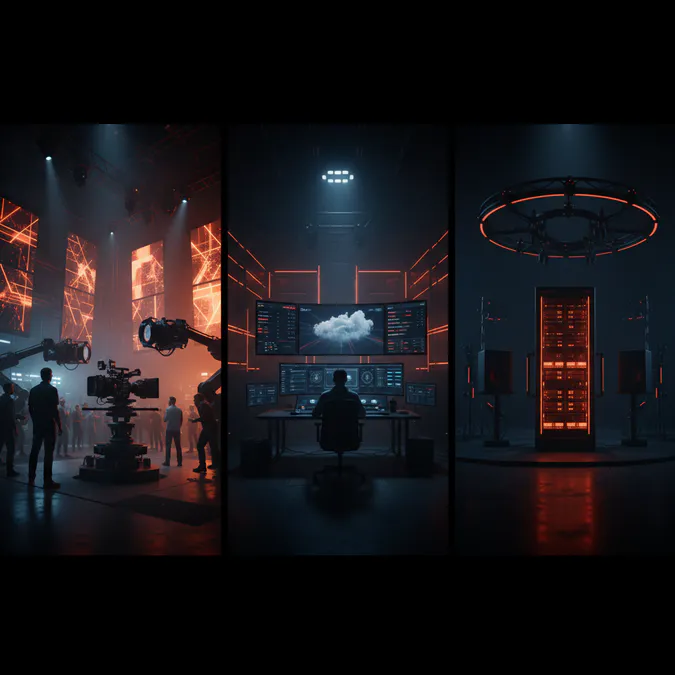
Virtual production using LED stages represents a paradigm shift in how event environments are created and captured. Rather than relying on physical sets, lighting rigs, and location scouting, event producers can now create immersive, branded environments using LED stage technology integrated with digital content.
Dynamic Visual Environments
LED stages display photorealistic backgrounds and dynamic visual elements that respond to camera movement in real-time. This technology enables event producers to create multiple branded environments within a single event, customize visuals for different segments or sponsors, and adapt environments based on real-time feedback without physical changes to the venue.
The integration of virtual production with AI post-production tools creates a seamless workflow from capture to delivery. LED stage content can be enhanced, color-graded, and refined using AI editing suites, ensuring consistency across all event footage. For corporate events, product launches, and branded experiences, this combination creates professional-quality productions that rival traditional broadcast standards.
Cost Efficiency and Creative Flexibility
Virtual production also reduces costs associated with physical set construction, location fees, and extensive lighting equipment. Event producers can allocate budgets toward content quality and creative direction rather than physical infrastructure. For multi-day events, the flexibility of LED stages means different visual themes can be deployed for different sessions without production delays.
This flexibility encourages experimentation and creative risk-taking. Producers can test different visual approaches, adjust branding elements, and respond to real-time feedback without the constraints and costs associated with physical set changes. The result is more dynamic, engaging event experiences that adapt to audience response and evolving creative direction.
Same-Day Content Delivery: Meeting Modern Event Demands
One of the most transformative aspects of AI-powered editing and cloud-based workflows is the ability to deliver polished, professional-quality content on the same day as the event. This capability has become increasingly important as event organizers recognize the value of immediate content distribution for social media, attendee engagement, and sponsor satisfaction.
Compressing Production Timelines
Traditional event video production required days or weeks of post-production work after the event concluded. Color grading, sound mixing, effects, and graphics all needed to be completed sequentially, with each stage dependent on the previous one. This timeline meant that event content often arrived long after attendees had moved on to other priorities.
AI automation compresses this timeline dramatically. Color grading that once required hours of manual adjustment can now be accomplished in minutes using AI algorithms that analyze footage and apply consistent, professional-quality color correction. Sound mixing, noise removal, and dialogue enhancement happen automatically, with human sound engineers reviewing and refining rather than performing these tasks from scratch.
Enabling Creative Focus
As one expert noted during the InfoComm 2026 session on AI video editing workflows, "AI isn't replacing editors—it's removing the bottlenecks that slow great storytelling." This perspective captures the true value of these technologies: they enable creative professionals to focus on narrative, pacing, and impact rather than technical execution.
Real-Time Engagement Opportunities
Same-day delivery also creates opportunities for real-time engagement. Event organizers can share highlights with attendees while the event is still fresh in their minds, extend the event experience beyond the physical venue, and capitalize on immediate social media momentum. Sponsors receive content quickly for their own marketing purposes, and attendees can relive key moments without waiting weeks for professional-quality video.
This immediacy transforms how events are experienced and remembered. Rather than event content being a delayed artifact, it becomes part of the live experience itself, with highlights shared in real-time and extended engagement continuing long after the event concludes.
Practical Implementation and Cost Considerations
Implementing these technologies requires understanding both the capabilities and the practical considerations of different platforms. The choice between WaveSpeedAI, DaVinci Resolve, Runway AI, Adobe Premiere Pro, and Movavi Video Editor AI depends on specific production needs, team expertise, and budget constraints.
Choosing the Right Platform
For event production teams seeking comprehensive end-to-end solutions, WaveSpeedAI's unified API and access to 600+ AI models provide flexibility and scalability. The platform's text-to-video generation capabilities enable producers to create supplementary content, graphics, and visual elements without external tools.
For teams already invested in DaVinci Resolve, the free version provides substantial AI capabilities at no cost, making it an excellent choice for budget-conscious operations. The $299 Studio version investment becomes worthwhile for teams requiring advanced features and professional support.
Runway AI's tiered pricing structure ($15-$95 per month) accommodates different production scales, from freelancers managing individual events to large production companies handling multiple simultaneous projects. The platform's emphasis on cloud collaboration makes it particularly valuable for distributed teams.
Adobe Premiere Pro integration with Firefly AI appeals to professionals already using Adobe's ecosystem, eliminating the need to learn new software while gaining AI capabilities within familiar workflows.
Movavi Video Editor AI's affordable pricing ($49.95/year) makes it accessible for small event production operations, though it may lack the advanced features required by larger productions.
Return on Investment
The financial investment in these technologies typically pays for itself through reduced production timelines and smaller team requirements. An event that previously required a week of post-production work from multiple specialists can now be completed in a day by fewer people, with higher quality results.
Beyond direct cost savings, these technologies enable new revenue opportunities. Event organizers can offer same-day highlight reels as premium services, extend content distribution across multiple platforms, and create supplementary content for sponsors. The ability to deliver professional-quality content quickly becomes a competitive advantage that justifies the technology investment.
The Future of Event Video Production
The technologies transforming event video production in 2026 represent just the beginning of a larger transformation. As AI capabilities continue to advance, we can expect even more sophisticated automation, more intuitive interfaces, and deeper integration between capture, production, and distribution systems.
Convergence and Innovation
The convergence of AI editing, cloud collaboration, and virtual production creates new possibilities for event experiences. Producers can experiment with multiple creative approaches quickly, test different visual styles, and iterate based on feedback without significant time or cost penalties. This flexibility encourages innovation and creative risk-taking that might have been prohibitively expensive in traditional workflows.
Democratization of Professional Production
For event organizers, these technologies democratize access to professional-quality production. Smaller events can now achieve broadcast-quality results that were previously accessible only to large-budget productions. This democratization expands the market for event video production and creates opportunities for new producers and creative professionals.
Evolution of Required Skills
The shift from manual labor to intelligent automation also changes the skill sets required in event production. Rather than needing specialists in color grading, sound mixing, and effects, teams need professionals who understand creative direction, storytelling, and how to leverage AI tools effectively. This evolution creates opportunities for producers to develop new expertise and for the industry to attract talent from adjacent fields.
As these technologies mature and become more accessible, the competitive advantage will shift from technical execution to creative vision and strategic thinking. Event producers who master these tools while maintaining focus on storytelling and audience engagement will thrive in this new landscape.
The Bottom Line
The event video production industry in 2026 is experiencing a transformation driven by AI-powered editing suites, cloud-based workflows, and virtual production technologies. These tools are not replacing human creativity and expertise—they're amplifying it by removing technical bottlenecks and enabling faster, more efficient production processes.
For event professionals, understanding and adopting these technologies is becoming essential for remaining competitive. Whether you're managing corporate conferences, product launches, or branded experiences, the ability to deliver professional-quality content quickly and cost-effectively has become a key differentiator. The platforms available today—from comprehensive solutions like WaveSpeedAI to accessible options like DaVinci Resolve and Movavi—provide entry points for productions of any size.
The future of event video production belongs to teams that embrace these technologies while maintaining focus on storytelling, creativity, and audience engagement. The technical barriers that once limited event video quality are rapidly disappearing, leaving creative vision and execution as the primary factors determining success. By adopting these tools strategically and investing in team training, event production companies can position themselves at the forefront of this transformation.
Frequently Asked Questions
What is AI event video production?
AI event video production refers to the use of artificial intelligence technologies to automate various aspects of video production, including editing, color grading, and sound mixing, enabling faster and more efficient workflows.
How does cloud-based workflow benefit event production?
Cloud-based workflows allow distributed teams to collaborate in real-time, reducing delays associated with file transfers and enabling simultaneous work on projects, which accelerates production timelines.
What are the advantages of using LED stages in virtual production?
LED stages provide dynamic visual environments that can be customized in real-time, reducing costs associated with physical set construction and allowing for creative flexibility during events.
Can same-day content delivery improve audience engagement?
Yes, same-day content delivery allows event organizers to share highlights while the event is still fresh in attendees' minds, enhancing engagement and extending the event experience beyond the physical venue.
What skills are needed for modern event production?
Modern event production requires professionals who understand creative direction, storytelling, and how to effectively leverage AI tools, rather than just technical specialists in traditional roles.