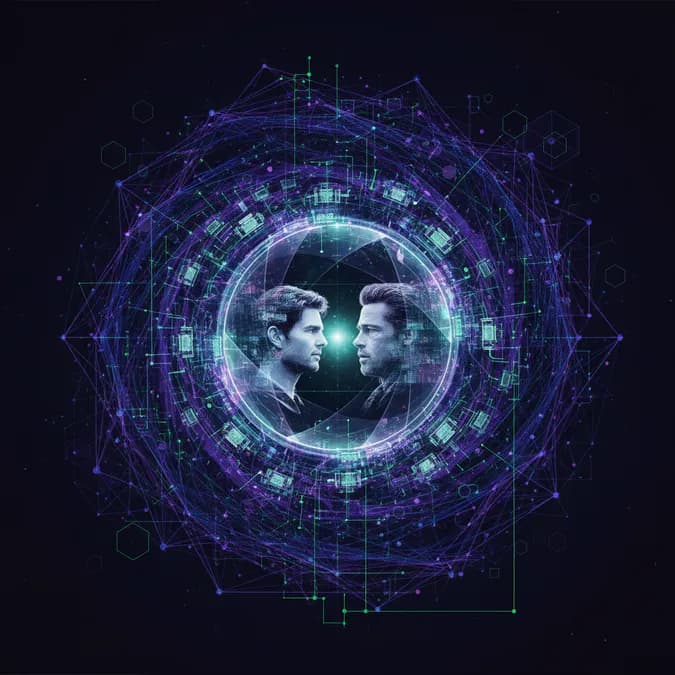
A groundbreaking artificial intelligence video has sent shockwaves through Hollywood, demonstrating how advanced synthetic media technology has become. The 15-second clip, created using an AI tool owned by ByteDance, depicts Tom Cruise and Brad Pitt in a cinematic battle sequence that appears more polished than previous deepfake attempts. This development marks a significant milestone in AI video generation capabilities, raising urgent questions about intellectual property protection, consent, and the future of entertainment production.
The AI Video That Shocked Hollywood
The 15-second synthetic video created by ByteDance's technology represents a watershed moment in generative AI. Unlike earlier deepfakes that often contained obvious artifacts and inconsistencies, this video demonstrates cinematic quality that rivals professional production standards. The clip's realism and polish have alarmed industry professionals who recognize the implications for unauthorized celebrity likenesses.
The video's emergence highlights the rapid advancement of generative AI tools in the video technology space. ByteDance's technology demonstrates capabilities that suggest major technology companies are investing heavily in synthetic media development. The sophistication of the result indicates that AI video generation has moved beyond experimental proof-of-concepts into practical, production-quality territory.
What This Technology Means for Video Production
The ByteDance video demonstrates several critical capabilities in modern AI video generation:
- Realistic facial animation and expression mapping
- Cinematic lighting and color grading
- Coherent action sequences with proper physics
- Seamless integration of synthetic elements into believable scenes
- Processing speed that enables rapid iteration and refinement
These capabilities have legitimate applications in film production, visual effects, and content creation. However, the same technology can be weaponized to create unauthorized synthetic media of real people without consent or involvement.
How Studios Are Responding
Hollywood studios and talent representatives are now grappling with the implications of this technology. The ability to create convincing synthetic videos of major celebrities without their consent presents legal, ethical, and commercial challenges that existing regulations may not adequately address.
Studios are considering new protective measures including:
- Updated contractual language protecting digital likenesses
- Digital rights management strategies for actor images
- Technological solutions for synthetic media detection
- Industry standards for ethical AI use in production
- Authentication systems for verifying authentic footage
The Road Ahead for Synthetic Media
The incident underscores the need for industry-wide standards and protective measures. As AI video generation technology continues to advance, the entertainment industry faces a critical juncture. The ByteDance video demonstrates that the technology is no longer theoretical—it's operational, accessible, and capable of producing results that challenge traditional notions of authenticity in visual media.
Policymakers are beginning to examine whether existing laws adequately protect individuals from unauthorized synthetic media creation. The incident highlights the urgent need for collaboration between technology companies, studios, talent representatives, and regulators to establish guardrails around synthetic media creation. Without proactive measures, the line between authentic and artificial content will continue to blur, with significant consequences for intellectual property, privacy, and trust in digital media.
The ByteDance video serves as a wake-up call for the entertainment industry to develop proactive strategies for managing AI-generated content. This includes technical solutions for detecting synthetic media, legal frameworks for protecting likeness rights, and industry standards for ethical AI use in production.
Key Takeaways
- The recent AI video generation technology poses challenges and opportunities for Hollywood.
- Industry professionals are concerned about unauthorized use of celebrity likenesses.
- Studios are exploring new legal and technological measures to protect digital rights.
- Collaboration among stakeholders is essential for establishing effective regulations.
- Proactive strategies are needed to manage the implications of AI-generated content.