The best 8K cameras 2026 represents a watershed moment for professional video production. Shooting in 8K feels like a genuine glimpse into the future of filmmaking, and in 2026, high-resolution video technology has transitioned from experimental territory into practical production tools for serious filmmakers, broadcasters, and content creators. While 8K resolution still hasn't become the universal industry standard, the technology has matured significantly, with major streaming platforms, broadcasters, and camera manufacturers all investing heavily in this space.
This comprehensive guide explores the current state of 8K cameras 2026 offers, examines the leading camera systems available today, and helps you understand whether high-resolution shooting makes sense for your projects.
Understanding 8K and 6K Video Resolution
8K resolution delivers 7680 x 4320 pixels, providing four times the pixel density of 4K video. This dramatic increase in resolution enables unprecedented detail capture, allowing cinematographers to preserve intricate textures, fine details, and subtle color gradations that would be lost in lower resolutions. The extra resolution also provides significant pos
6K resolution, at 6144 x 3160 pixels, exists as an intermediate format between 4K and 8K. Theoretically, it offers a compromise between resolution and workflow efficiency. However, 6K has struggled to find its place in professional production, largely because it doesn't align neatly with either 4K delivery standards or the full capabilities of 8K systems.
The jump to 8K isn't merely about pixel count. Modern 8K cameras in 2026 offer internal recording at 60fps or higher with unlimited recording times, eliminating the technical limitations that plagued earlier generations. Advanced autofocus systems with AI-driven subject tracking have become standard, enabling complex hybrid shooting scenarios where cinematographers can capture both cinema-quality video and high-resolution still photography from the same device.
Current State of 8K Adoption in 2026
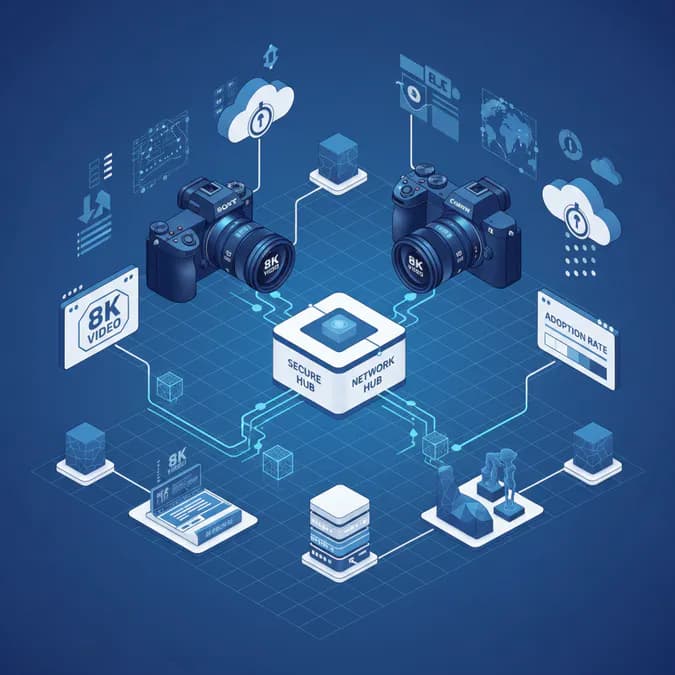
The 8K market has experienced remarkable growth. Professional filmmaking adoption rates increased 34% year-over-year between 2025 and 2026, according to the Professional Video Production Association Report. This acceleration reflects genuine industry confidence in the technology's maturity and practical applicability.
Broadcaster support has expanded dramatically. The International Broadcasting Union Technical Report indicates that 62% of major broadcasters now support 8K content delivery as of Q1 2026. This represents a critical inflection point—when major distribution channels commit to a format, production workflows and equipment investments follow naturally.
Streaming platforms have become major drivers of 8K adoption. Netflix and Amazon Prime Video announced expanded 8K content slates in March 2026, committing to 8K original content production and signaling an industry-wide shift toward high-resolution standards. Both services established partnerships with camera manufacturers to optimize workflows specifically for their platforms.
However, industry professionals offer important perspective on the current landscape. Emmy-nominated cinematographer and Director of Photography James Chen notes: "8K has transitioned from experimental to practical for high-end productions. The real challenge now isn't camera capability—it's infrastructure. Storage, editing systems, and delivery platforms are the bottlenecks." This insight captures the current reality—the cameras are ready, but the supporting ecosystem is still catching up.
Leading 8K Camera Systems
Several professional-grade 8K mirrorless cameras have emerged as industry leaders in 2026, each offering distinct capabilities for different production scenarios.
Sony A1 II
The Sony A1 II represents one of the most capable hybrid systems available among 8K cameras 2026 professionals recommend. With 61MP resolution and 8K/60p recording capability, the A1 II delivers exceptional performance for both stills and cinema work. The camera's advanced autofocus system with AI-driven subject tracking makes it particularly valuable for complex production scenarios where manual focus would be impractical.
Nikon Z9
Nikon Z9 offers 45.7MP resolution with 8K/60p recording, establishing itself as a serious competitor in the professional mirrorless space. The Z9's robust build quality and extensive lens ecosystem make it attractive for productions requiring reliability and flexibility. Its performance in demanding shooting conditions has made it a favorite among documentary and broadcast professionals.
Canon EOS R5 Mark II and Mark III
Canon EOS R5 Mark II represents Canon's flagship offering. In March 2026, Canon released the EOS R5 Mark III with enhanced 8K/120fps capability, addressing previous overheating concerns that had limited high-resolution shooting in earlier models. This advancement represents a significant engineering achievement, enabling sustained 8K recording in demanding production environments.
Fujifilm X-H2
Fujifilm X-H2 provides an APS-C alternative, delivering 40MP resolution with 8K/30p recording. While the frame rate is lower than full-frame competitors, the X-H2's compact form factor and Fujifilm's renowned color science make it attractive for certain production scenarios, particularly for independent filmmakers and smaller production teams.
Senior Technology Analyst at the Professional Imaging Association Dr. Michael Rodriguez observes: "The Sony A1 II and Nikon Z9 represent a fundamental shift in hybrid camera design. These aren't compromises anymore—they're genuinely professional tools for both stills and cinema work." This assessment reflects how far the technology has advanced—these cameras no longer force filmmakers to choose between stills and video capabilities.
The 6K Question: Why It Hasn't Taken Off
Despite existing as a technical option, 6K has failed to achieve meaningful adoption in professional production. The reasons are straightforward: 6K sits awkwardly between 4K and 8K without clear advantages in either direction.
Most productions optimize for 4K delivery because that's where the market currently exists. Television broadcasts, streaming platforms, and theatrical releases predominantly target 4K as their distribution standard. Shooting in 6K for 4K delivery wastes resolution and creates unnecessary storage and processing overhead.
Conversely, productions committing to high-resolution work typically go all the way to 8K. The additional resolution provides meaningful creative and technical advantages—better post-production flexibility, superior detail preservation, and future-proofing for emerging distribution standards.
Post-Production Supervisor at a major motion picture studio Sarah Williams explains: "6K remains underutilized because it sits awkwardly between 4K and 8K. Most productions either optimize for 4K delivery or commit fully to 8K workflows. The middle ground hasn't found its audience yet." This professional perspective confirms that 6K's lack of adoption reflects practical workflow considerations rather than technical limitations.
8K vs 6K: Choosing the Right Resolution
For most professional productions in 2026, the choice isn't really between 8K and 6K—it's between 4K and 8K. Understanding when to invest in 8K cameras 2026 technology requires evaluating your specific production needs.
Choose 8K if your production involves:
- High-end commercial work requiring maximum detail and post-production flexibility
- Documentary projects where you might need to reframe or stabilize footage in post-production
- Broadcast content destined for premium distribution channels
- Projects with significant budgets that can accommodate 8K infrastructure requirements
- Hybrid stills-and-video work where you need maximum resolution for both applications
Stick with 4K if your production involves:
- Standard broadcast or streaming delivery
- Projects with limited storage and processing infrastructure
- Fast-turnaround content where post-production efficiency matters more than maximum resolution
- Situations where your distribution channels don't support 8K playback
The 6K middle ground remains largely theoretical. Unless you have a specific technical reason to shoot 6K—which is rare in 2026—you're better served by choosing either 4K or 8K based on your actual delivery requirements and infrastructure capabilities.
Storage, Workflow, and Infrastructure Challenges
High-resolution video production demands serious infrastructure planning. 8K video requires 1.5 to 2.2 TB of storage per hour of footage, according to Digital Cinema Society Technical Guidelines. This represents a substantial commitment—a single day of shooting can consume multiple terabytes of storage.
These storage requirements cascade through your entire workflow. You need:
- Robust backup systems to protect irreplaceable footage
- High-speed storage networks capable of handling 8K data rates
- Powerful editing systems with sufficient processing power for real-time playback
- Color grading workstations equipped for 8K processing
- Archive systems for long-term footage preservation
The infrastructure challenge extends beyond storage. Processing 8K footage requires significantly more computational power than 4K work. Editing, color correction, and effects work all demand more powerful hardware and longer processing times.
Recent industry developments have begun addressing these challenges. In February 2026, the International Telecommunication Union approved a new 8K codec for professional broadcasting, reducing storage and bandwidth requirements by 40%. This compression standard represents a meaningful step toward making 8K workflows more practical and affordable.
Pricing and Value Proposition
Professional-grade 8K mirrorless cameras in 2026 range from $4,500 to $6,800 for the camera body alone, according to B&H Photo Video Market Analysis. This pricing reflects the technology's maturity—8K cameras are no longer exotic, experimental equipment but rather established professional tools.
However, the camera body represents only a portion of your total investment. You'll also need:
- High-capacity, fast storage media (CFast, XQD, or equivalent)
- Backup and archive storage systems
- Upgraded editing and color grading workstations
- Potentially new lenses optimized for 8K resolution
- Training and workflow development
For many productions, the total infrastructure investment for 8K work can reach $15,000 to $30,000 or more. This explains why 8K adoption remains concentrated in high-budget productions where the investment can be justified by project scope and distribution value.
The value proposition becomes clearer when you consider the creative and technical advantages. 8K resolution provides genuine post-production flexibility—you can reframe shots, apply digital zoom, and perform stabilization without sacrificing image quality. For high-end commercial work, broadcast content, and premium streaming productions, these capabilities justify the investment.
The Future of High-Resolution Video Production
The trajectory is clear: 8K will continue expanding as the industry standard for high-end production. Several factors support this evolution:
Broadcaster Commitment
With 62% of major broadcasters now supporting 8K delivery, distribution infrastructure is solidifying. As more platforms support 8K, production investment becomes more justified.
Camera Technology Maturity
The latest generation of 8K cameras addresses previous limitations. Canon's EOS R5 Mark III with 8K/120fps capability demonstrates that thermal management and sustained recording challenges are being solved.
Streaming Platform Investment
Netflix and Amazon Prime Video's commitment to 8K original content signals that streaming—the dominant distribution channel—is embracing high resolution.
Codec Improvements
The new ITU-approved 8K codec reducing storage requirements by 40% makes workflows significantly more practical and affordable.
Hybrid Workflow Maturity
Modern 8K cameras seamlessly handle both stills and video, eliminating the need for separate equipment and workflows.
However, 8K won't become truly universal in 2026. Consumer adoption remains limited, theatrical releases continue optimizing for 4K, and many broadcast applications don't require 8K resolution. The technology will remain concentrated in premium production segments—high-end commercials, prestige television, premium streaming content, and specialized documentary work.
Frequently Asked Questions About 8K Cameras 2026
What is the difference between 8K and 4K resolution?
8K resolution (7680 x 4320 pixels) provides four times the pixel density of 4K (3840 x 2160 pixels). This means 8K captures significantly more detail, offers greater post-production flexibility for reframing and stabilization, and future-proofs content for emerging distribution standards. However, 8K requires substantially more storage, processing power, and infrastructure investment.
Is 8K worth the investment for my production?
8K is worth the investment if your production involves high-end commercial work, premium broadcast content, or prestige streaming projects where the additional detail and post-production flexibility justify the infrastructure costs. For standard broadcast or streaming delivery, 4K remains the practical choice. Evaluate your actual delivery requirements, budget constraints, and infrastructure capabilities before committing to 8K workflows.
Which 8K camera should I choose?
The best 8K camera depends on your specific needs. The Sony A1 II excels for hybrid stills-and-video work. The Nikon Z9 offers robust build quality and extensive lens support. The Canon EOS R5 Mark III provides the highest frame rates (8K/120fps). The Fujifilm X-H2 offers a compact APS-C alternative. Consider your workflow requirements, lens ecosystem, and budget when selecting a camera.
How much storage do I need for 8K video?
8K video requires approximately 1.5 to 2.2 TB of storage per hour of footage, depending on codec and frame rate. A single day of shooting can consume multiple terabytes. Plan for redundant backup systems, high-speed storage networks, and long-term archive solutions when budgeting for 8K production infrastructure.
Will 8K become the standard for all video production?
8K will likely remain concentrated in premium production segments for the foreseeable future. While broadcaster support and streaming platform investment are growing, consumer adoption remains limited, and many applications don't require 8K resolution. 4K will continue as the practical standard for most broadcast and streaming delivery, while 8K serves high-end commercial, prestige television, and specialized documentary work.
Key Takeaways
High-resolution video production in 2026 represents a genuine inflection point. 8K technology has matured from experimental to practical, with professional adoption increasing 34% year-over-year. Major broadcasters and streaming platforms now support 8K delivery, and camera manufacturers have delivered systems that genuinely perform as professional tools.
The best 8K cameras 2026 offers—Sony A1 II, Nikon Z9, Canon EOS R5 Mark III, and Fujifilm X-H2—represent the current generation of capable systems, each offering distinct advantages depending on your specific needs and workflow preferences.
6K remains underutilized because it doesn't align with either 4K delivery standards or the full capabilities of 8K systems. For most productions, the choice is between 4K and 8K based on your actual delivery requirements and infrastructure capabilities.
The real challenges in 8K production aren't camera capability—they're infrastructure. Storage requirements of 1.5 to 2.2 TB per hour, processing power demands, and workflow complexity represent the actual bottlenecks. However, recent developments including improved codecs and maturing professional workflows are making 8K increasingly practical.
If your production involves high-end commercial work, premium broadcast content, or prestige streaming projects, 8K represents a genuine investment in quality and creative flexibility. For standard broadcast or streaming delivery, 4K remains the practical choice. Either way, understanding the current state of high-resolution technology helps you make informed decisions about your production infrastructure and workflow investments.