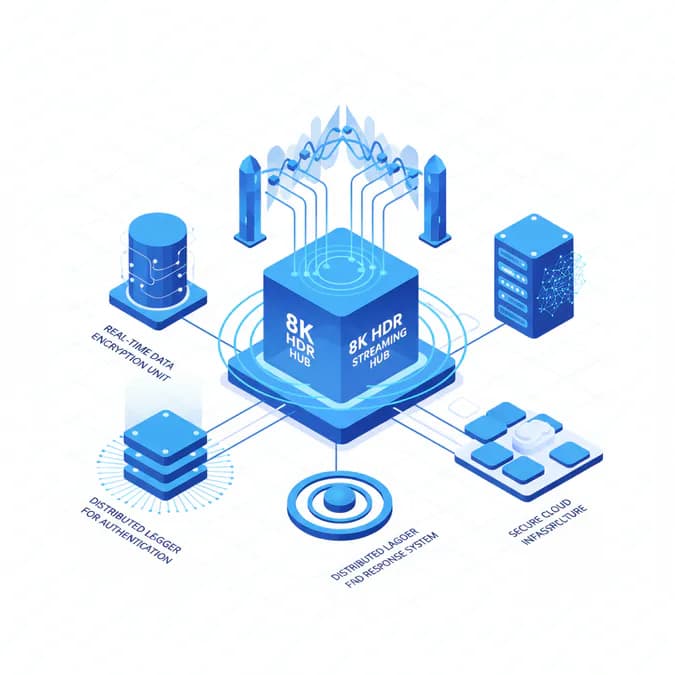
Real-time 8K HDR streaming represents a fundamental shift in how live video content is produced and delivered to global audiences. With resolutions reaching 7680x4320 pixels—16 times that of standard HD—combined with High Dynamic Range technology for enhanced contrast and color depth, this emerging format is redefining expectations for live events, particularly in music production and sports broadcasting.
The global 8K technology market reached USD 20.03 billion in 2025 and is projected to grow at a compound annual growth rate of 33.5% through 2035, according to Research Nester. This explosive growth reflects genuine industry momentum, though the path to mainstream adoption involves navigating significant technical and economic challenges.
Understanding 8K HDR Streaming Technology
8K resolution delivers 33 million pixels of unprecedented detail, fundamentally changing how viewers experience live content. When combined with High Dynamic Range technology, the result is lifelike colors, enhanced contrast, and brightness levels that create immersive visual experiences previously impossible in live streaming.
The distinction

HDR technology amplifies this advantage by expanding the range of colors and brightness levels that can be displayed. Traditional SDR (Standard Dynamic Range) content uses a limited color gamut and brightness range, while HDR content can represent colors and brightness levels much closer to what the human eye perceives in real life. This combination of ultra-high resolution and enhanced color science creates a compelling case for premium live events.
Technical Advancements Enabling Real-Time Delivery
Several technological breakthroughs are making real-time 8K HDR streaming feasible by 2026. These advancements address the primary challenge of delivering such massive data streams with minimal latency.
Advanced Compression Codecs
Advanced compression codecs represent a critical enabler. The Versatile Video Coding (VVC) standard, demonstrated during Intel's deployment at the Paris Olympics 2024, provides significantly better compression than previous standards. This allows 8K content to be transmitted with lower bandwidth requirements while maintaining visual quality.
GPU-Accelerated Hardware Encoding
Dedicated hardware encoders using GPU acceleration have become essential infrastructure. Rather than relying on CPU-based encoding, which introduces latency and consumes excessive processing power, GPU-accelerated encoding handles the computational demands of real-time 8K processing. This hardware-based approach enables sub-second latency—critical for live music events where audio-visual synchronization is essential.
Edge Delivery Networks
Edge delivery networks and smart routing minimize transmission delays by processing content closer to end-users. Instead of routing all data through centralized servers, edge computing distributes the processing load geographically, reducing the distance data must travel and the latency it accumulates.
Adaptive Bitrate Streaming
Adaptive bitrate streaming technology allows the system to adjust quality dynamically based on available bandwidth. Rather than delivering a fixed bitrate stream that may buffer or fail on slower connections, adaptive streaming scales the quality up or down in real-time, ensuring reliable delivery across diverse network conditions.
Applications in Live Music Events and Sports
Live music events represent the primary proving ground for real-time 8K HDR streaming technology. The music industry benefits uniquely from this technology because it demands both ultra-high visual quality and extremely low latency. When a performer plays an instrument, the audio and video must synchronize perfectly for the viewer experience to feel authentic.
Intel's 8K live-streaming deployment at the Paris Olympics 2024 marked the largest real-world implementation of 8K streaming with VVC codec technology. This demonstration proved that real-time 8K delivery was no longer theoretical—it could work at scale for major global events.
Sports broadcasting is another critical application area. The ability to capture fine details—a tennis player's serve technique, a golfer's swing mechanics, or a soccer player's footwork—in 8K resolution provides unprecedented insight for viewers. Combined with HDR's enhanced color and contrast, sports content becomes more engaging and analytically valuable.
As noted by a technology analyst at Live Music Blog, "Real-time 8K HDR live streaming is no longer a lab experiment or technical demonstration. It has now emerged as a serious production format due to the increased expectations of viewers." This shift from experimental technology to production-ready format marks a significant milestone in the industry.
Bandwidth and Infrastructure Requirements
One of the most significant challenges in 8K HDR streaming is bandwidth consumption. Reliable 8K streaming requires 50-100+ Mbps of bandwidth, compared to approximately 25 Mbps for 4K content, according to Display Daily. This represents a doubling or quadrupling of bandwidth requirements, which has profound implications for infrastructure planning.
For context, this bandwidth demand means that 8K streaming requires substantially more robust network infrastructure than current 4K streaming. While fiber-optic networks and 5G technology are expanding globally, many regions still lack the infrastructure to reliably support 8K streaming at scale.
The 2026 production workflows being developed address these challenges through several mechanisms:
- 6GHz Wi-Fi integration provides additional spectrum for wireless transmission
- Adaptive streaming algorithms optimize bandwidth usage by adjusting resolution and frame rates based on real-time network conditions
- Smart routing protocols direct data through the most efficient network paths, minimizing congestion and latency
- GPU-accelerated processing reduces computational overhead and enables efficient real-time encoding
The Role of AI Upscaling and Advanced Codecs
Artificial intelligence is playing an increasingly important role in making 8K content more accessible and economically viable. AI upscaling technology can enhance 4K content to near-8K quality by intelligently inferring details and improving resolution.
According to a technology trends editor at 7md.ae, "By 2026, this AI upscaling will have advanced to the point where the difference between true 8K content and upscaled 4K material becomes nearly imperceptible to the human eye on screens larger than seventy inches." This development has profound implications for content creators and broadcasters.
If AI upscaling can produce visually indistinguishable results from native 8K at a fraction of the bandwidth and processing cost, the economic case for native 8K production becomes more nuanced. Content creators might produce in 4K and upscale for distribution, reducing production costs while maintaining perceived quality.
Next-Generation HDR Standards
Advanced HDR standards are also evolving. Dolby Vision 2 and HDR10+ represent the next generation of HDR technology, incorporating AI-adaptive tone mapping and studio metadata for hyper-realistic visuals. These standards launched in early 2026 and are being integrated into production workflows alongside 8K resolution capabilities.
These advanced HDR formats provide benefits that are often more immediately noticeable to viewers than the resolution increase from 4K to 8K, particularly on displays under 75 inches. The enhanced color gamut, brightness range, and dynamic tone mapping create more lifelike and engaging visual experiences.
Challenges and Industry Perspectives
Despite the technological progress, significant challenges remain. The consumer 8K TV market has faced headwinds, with major manufacturers reassessing their 8K strategies. LG ended its 8K QNED line for 2026, shifting focus to 4K OLED and MiniLED technologies, while Samsung remains the primary pusher of 8K consumer displays.
This divergence between production-side adoption and consumer-side hesitation reflects broader industry debates about the necessity of native 8K. As a technology reviewer at T3 noted, "While 8K might have sounded like a grand idea... it just doesn't have the reach, nor the necessity to make sense." This perspective highlights the economic reality that 8K's benefits may be limited to specific use cases rather than universal adoption.
The Content Scarcity Problem
The content scarcity problem is real. Without sufficient 8K content available, consumers have little incentive to purchase 8K displays. Conversely, without a substantial installed base of 8K-capable displays, content creators lack motivation to produce in 8K. This chicken-and-egg dynamic has slowed broader market adoption.
4K Plus HDR as an Alternative
Many industry professionals argue that 4K combined with advanced HDR technology provides a more practical and economically viable path forward. The visual improvements from HDR—enhanced color, contrast, and brightness—are often more noticeable to viewers than the resolution increase from 4K to 8K, particularly on displays under 75 inches.
This perspective doesn't dismiss 8K technology but rather positions it as a premium option for specific high-value applications rather than a universal standard. For most content creators and broadcasters, the return on investment for native 8K production may not justify the additional costs and complexity.
Looking Ahead to 2026 and Beyond
The 2026 timeline represents a critical inflection point for 8K HDR streaming technology. By this year, the technological infrastructure—advanced codecs, GPU-accelerated encoding, edge delivery networks, and adaptive streaming—will be mature enough for production use. The question is not whether the technology works, but where it makes economic and practical sense to deploy it.
Premium Live Events and Sports
For live music events and premium sports broadcasts targeting global audiences, real-time 8K HDR streaming offers genuine value. The ability to deliver ultra-detailed, immersive content with minimal latency creates experiences that justify the infrastructure investment for high-value events. Major music festivals, championship sporting events, and premium streaming services will likely lead adoption in this space.
Flexible Production Workflows
The integration of AI upscaling, advanced HDR standards, and efficient compression codecs means that 8K production workflows will become increasingly flexible. Content creators will have options:
- Produce natively in 8K for maximum quality and detail
- Produce in 4K and upscale using AI for cost efficiency
- Produce in 4K with advanced HDR for visual impact at lower bandwidth
- Hybrid approaches combining multiple techniques
Each approach offers different trade-offs between quality, cost, and bandwidth requirements. The flexibility to choose the right approach for each project represents a significant advantage over previous years when options were more limited.
Market Growth and Segmentation
Market projections suggest continued growth, with the 8K sector expanding at 33.5% CAGR through 2035. However, this growth will likely be concentrated in specific segments—premium live events, sports broadcasting, and high-end production—rather than universal consumer adoption.
The industry is moving toward a more segmented approach where 8K is recognized as a premium format for specific applications rather than a universal standard. This maturation of the market reflects a realistic assessment of where 8K technology provides genuine value and where alternative approaches may be more practical.
Key Takeaways for Video Professionals
For the video production industry, the key takeaway is that 2026 marks the transition of 8K HDR streaming from experimental technology to production-ready format. Whether your organization chooses to adopt native 8K production, leverage AI upscaling, or focus on 4K with advanced HDR, the technological options available are more sophisticated and flexible than ever before.
The decision should be driven by your specific content, audience, and economic constraints rather than assuming 8K is universally necessary. Understanding the capabilities and limitations of each approach—native 8K, AI upscaling, advanced HDR, and combinations thereof—will be essential for making informed production decisions in 2026 and beyond.
The convergence of advanced compression codecs, GPU acceleration, edge delivery networks, and AI-powered enhancement technologies has created an ecosystem where high-quality, low-latency streaming is achievable across multiple resolution and quality tiers. This flexibility represents the true innovation of the 2026 production landscape.
Sources
- Automated Pipeline
- Rise of Real-Time 8K HDR Streaming in 2026 Video Production
- Smart TV Technology Trends in 2026: Redefining Home Entertainment
- 8K Technology Market Size, Growth Trends & Forecast to 2035
- The 8K TV Experiment Is Over
- So long 8K, you won't be missed – why new TV tech is more integral anyway
- Source: pocket-lint.com
- Source: youtube.com