
Video production is undergoing a rapid transformation, and 2026 is shaping up to be a pivotal year. The industry is seeing a convergence of hybrid content creation, AI-assisted workflows, and increasing demand for 3D animation. These trends are not just fleeting fads but represent a fundamental shift in how video content is produced and consumed. Understanding these changes is crucial for anyone involved in video production, from individual creators to large studios. This article will delve into the key trends defining video production in 2026, providing insights and actionable information to help you stay ahead of the curve.
The Evolution of Video Production
The video production landscape in 2026 is markedly different from what it was just a few years ago. Traditional, control-focused workflows are giving way to systems optimized for relevance, speed, and scalability. This evolution is driven by three major forces: AI-assisted automation, hybrid content creation (blending live action with animation), and audience demand for au
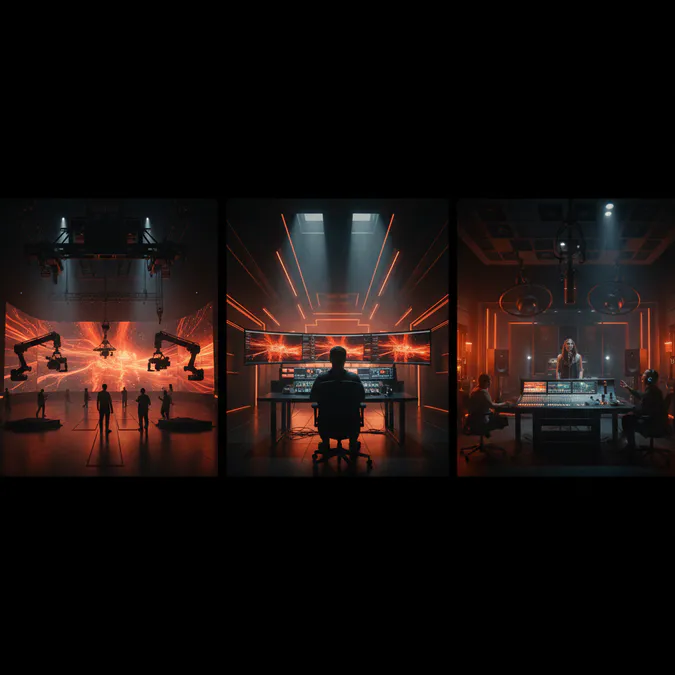
Hybrid Content: Blending Multiple Media Formats
One of the most significant trends in video production is the rise of hybrid content. This approach combines live action, 2D animation, 3D animation, and motion graphics to create engaging and dynamic videos. Hybrid content allows brands to showcase real-world environments while simultaneously visualizing abstract concepts and ideas. According to the Motion Graphics Industry Report 2026, there has been a 68% increase in hybrid content production projects year-over-year [Motion Graphics Industry Report 2026].
Key Benefits of Hybrid Content
- Enhanced Storytelling: Blending different media formats allows for more creative and engaging storytelling.
- Improved Visual Communication: Animation and motion graphics can simplify complex information and make it easier to understand.
- Increased Audience Engagement: Hybrid content is more visually appealing and can capture the attention of viewers more effectively.
Marcus Rodriguez, Head of Creative Strategy at Motion Design Association, notes that "Hybrid content isn't a trend—it's the new baseline. Audiences expect brands to seamlessly blend live action with animation to tell complete stories. The technical barrier to entry has dropped significantly, but the creative execution is what separates premium content from the rest" [2026 Video Production Outlook].
AI Integration in Video Workflows
Artificial intelligence (AI) is rapidly transforming video production workflows. AI-assisted tools are now being used across various stages of production, including editing, captioning, script writing, and post-production. These tools automate time-consuming tasks, allowing creators to focus on more strategic and creative aspects of their work. According to a 2026 Video Production Industry Survey, 73% of video production teams are now using AI for at least one workflow component [2026 Video Production Industry Survey].
Areas Where AI is Making an Impact
- Editing: AI-powered editing tools can automatically detect scenes, organize clips, and even create rough cuts.
- Captioning: AI can generate accurate captions and subtitles, making videos more accessible to a wider audience.
- Script Writing: AI can assist with script writing by generating ideas, suggesting dialogue, and even creating entire scripts.
- Post-Production: AI can automate tasks such as color correction, audio mixing, and visual effects.
Forrester Research reports that 45% of production teams have increased their output capacity while maintaining or reducing headcount through AI-assisted workflows [Forrester Research: AI Video Editing Adoption 2026].
The Rise of 3D Animation in Commercial Applications
The demand for 3D animation is surging, particularly in the e-commerce and SaaS sectors. 3D animation is being used for product visualization and explainer videos, helping companies showcase their products and services in a visually appealing and informative way. The global 3D animation market is projected to reach $4.2 billion in 2026, with a 12.3% CAGR [Grand View Research].
Why 3D Animation is Gaining Popularity
- Enhanced Product Visualization: 3D animation allows companies to create realistic and detailed visualizations of their products.
- Improved Explainer Videos: 3D animation can simplify complex concepts and make them easier to understand.
- Increased Conversion Rates: Studies have shown that including 3D product demos in marketing campaigns can lead to higher conversion rates.
Jennifer Park, VP of Marketing Technology at Digital Commerce Institute, states, "Product visualization through 3D animation has become essential for e-commerce and SaaS companies. It's no longer a luxury—it's a competitive necessity. We're seeing 40% higher conversion rates when 3D product demos are included in marketing campaigns" [E-commerce Video Strategy Report 2026].
Balancing Automation with Human Creativity
While AI and automation are playing an increasingly important role in video production, human creativity remains central to success. AI functions as a creative partner and efficiency tool, rather than a replacement for strategic thinking and storytelling expertise. The most successful production teams are those that can effectively balance automation with human creativity.
Key Strategies for Balancing Automation and Creativity
- Focus on Strategic Thinking: Use AI to automate repetitive tasks, freeing up time for strategic planning and creative brainstorming.
- Embrace Human-in-the-Loop Workflows: Ensure that humans remain in control of the creative process, using AI as a tool to enhance their capabilities.
- Prioritize Storytelling: Remember that the most important aspect of any video is the story it tells. Use AI to enhance the storytelling process, not to replace it.
Sarah Chen, Director of Production at Hatch Studios, emphasizes that "AI isn't replacing creative directors—it's giving them superpowers. The teams winning in 2026 are those treating AI as a creative partner, not a replacement. The human eye, storytelling instinct, and strategic thinking remain irreplaceable" [Studio Daily Interview Series].
Industry Implications and Adoption Rates
The trends discussed above have significant implications for the video production industry. Production teams are adopting 'two-speed' strategies, combining short-form vertical content for reach with longer 'anchor' videos for trust and conversion, rather than choosing one format. The industry is also seeing a shift towards multi-format content production, with teams creating videos optimized for different platforms and devices.
Key Industry Implications
- Increased Efficiency: AI-assisted workflows are enabling production teams to produce more content with fewer resources.
- Improved Quality: Hybrid content and 3D animation are allowing for the creation of more visually appealing and engaging videos.
- Greater Reach: Multi-format content production is enabling companies to reach a wider audience across different platforms.
Tools and Technologies Enabling These Trends
Several tools and technologies are enabling the trends discussed above. These include:
- Adobe Premiere Pro: Adobe Premiere Pro launched AI-powered scene detection and auto-editing suite in March 2026, reducing editing time by an average of 35% while maintaining creative control [2026-03-15].
- Unreal Engine: Unreal Engine 5.4 released real-time hybrid rendering for live-action animation blending in February 2026, enabling seamless integration of live-action footage with 3D animation and motion graphics in production workflows [2026-02-28].
- Runway AI: Runway AI announced Video Generation 3.0 with enhanced creative control in early April 2026, featuring improved AI-assisted editing, advanced motion graphics generation, and better integration with professional editing software [2026-04-02].
Conclusion: Preparing for 2026 Production Standards
As we move closer to 2026, it's clear that the video production industry is undergoing a significant transformation. Hybrid content, AI-assisted workflows, and the rise of 3D animation are reshaping how videos are created and consumed. By understanding these trends and embracing the tools and technologies that enable them, video creators can stay ahead of the curve and thrive in the evolving landscape. The key is to balance automation with human creativity, using AI as a tool to enhance storytelling and improve efficiency, while always prioritizing the human element that makes videos engaging and impactful.