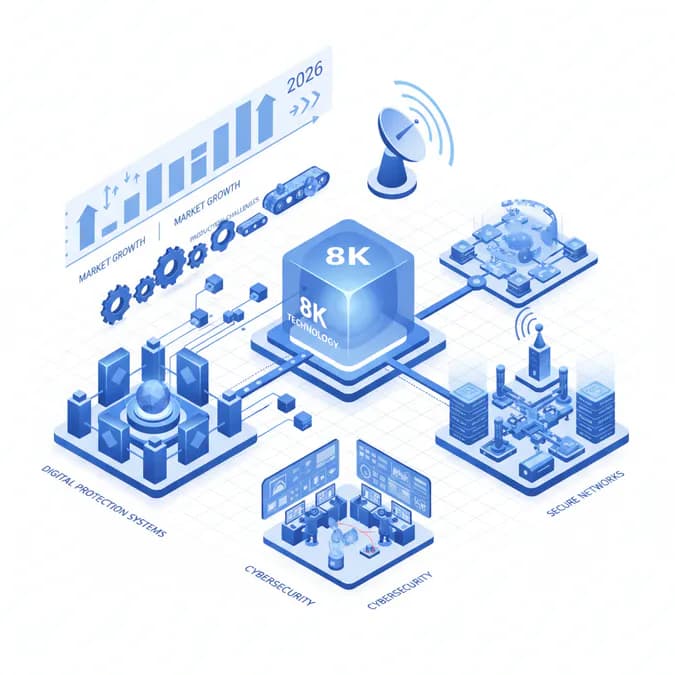
8K video technology represents a quantum leap in video technology, offering 7680 x 4320 pixels—approximately 33 million pixels per frame compared to 4K's 8.3 million. While consumer 8K displays are entering the market, the reality of widespread adoption remains complex. In 2026, native 8K content creation faces significant barriers, yet specialized professional fields are experiencing remarkable growth. Understanding the current landscape, challenges, and opportunities is essential for video professionals planning their technology investments.
8K Market Size and Growth Projections
The 8K market is experiencing substantial growth despite consumer hesitation. According to Research Nester, the 8K display resolution market was valued at USD 10.94 billion in 2026, with projections showing a 35% compound annual growth rate (CAGR) through 2035. The broader 8K technology market reached USD 32.24 billion in 2026 according to Research and Markets.
These figures reflect growing infrastructure investments and technological maturation, even as mainstream content production remains limited. More impressively, the 8K technology market is projected to reach USD 135.36 billion by 2030, representing a 43.1% CAGR from the 2026 baseline. This exponential growth trajectory suggests accelerating market momentum as infrastructure matures and production costs decline.
Global Media Content Investment
Global media content investment reached $255 billion in 2026, driven primarily by streaming platforms despite rising production costs, according to TV Technology. However, this substantial investment hasn't translated into widespread 8K content availability. The gap between investment and 8K adoption reveals a fundamental market challenge: production costs exceed consumer demand, creating a bottleneck in content creation.
Production Challenges and Equipment Costs
Native 8K content production requires specialized equipment and expertise that remains expensive in 2026. Professional-grade cameras like the Sony Venice 2 and RED V-Raptor enable high-end 8K capture, but their substantial cost confines usage to specialized projects. These cameras represent the pinnacle of 8K acquisition technology, offering cinema-grade image quality and extensive workflow integration.
Production Budget Requirements
High-end corporate video productions incorporating 8K cameras are estimated at $20,000–$50,000+ in 2026, according to Argus HD. This pricing structure creates a clear divide between professional applications and consumer-level production. The substantial investment required limits 8K adoption to organizations with specific technical requirements or substantial budgets.
AI-Powered Cost Reduction
AI-powered upscaling technology is beginning to address content scarcity by converting 4K and lower-resolution footage to 8K standards. Post-production savings through AI are projected at approximately 25% in 2026, making 8K workflows more economically viable. This technological bridge may accelerate adoption by reducing native production requirements and allowing creators to achieve 8K output without investing in specialized capture equipment.
Infrastructure and Storage Challenges
8K's massive file sizes require advanced storage solutions and substantial bandwidth for streaming. These technical requirements demand investment in backend systems before consumer-facing applications can scale effectively. Streaming platforms are making these investments, but adoption remains gradual as infrastructure upgrades progress across different regions and service providers.
Professional Applications Driving Adoption of 8K Video Technology
The professional video production sector is experiencing the most immediate 8K adoption. Medical imaging and surgical visualization represent 8K's strongest growth area, where pixel precision is critical for enhanced visualization that directly impacts diagnostic accuracy and surgical outcomes. Unlike consumer entertainment, where 8K content remains scarce, medical professionals actively adopt 8K technology for its tangible benefits.
Medical Imaging and Surgical Visualization
In specialized medical applications, 8K technology provides unprecedented detail for surgical visualization and diagnostic imaging. The pixel precision available in 8K resolution enables surgeons and medical professionals to identify subtle anatomical details that could be missed in lower resolutions. This application represents one of the most compelling use cases for 8K investment, where the technology's capabilities directly translate to improved patient outcomes.
Corporate and Commercial Production
Corporate video production is increasingly incorporating 8K elements, even when final delivery remains 4K. This hybrid approach allows companies to future-proof content while managing current distribution constraints. As 8K becomes more accessible, this practice will likely expand, with more organizations viewing 8K capture as a standard practice for high-value productions.
High-End Commercial Work
Luxury brands, automotive manufacturers, and premium consumer goods companies are investing in 8K production to differentiate their content and future-proof their assets. These organizations view 8K as a competitive advantage, allowing them to create content that will remain relevant as consumer display technology advances.
Regional Leadership and Market Dynamics in 8K Video Technology
Asia leads global 8K advancement, with Japan's NHK pushing technological boundaries. According to filmmaker, author, and colorist Alexis Van Hurkman from Signiant, "Asia, in general, is up on 8K. NHK is constantly pushing the limits, which by and large is extremely praiseworthy." This regional leadership creates opportunities for content creators and equipment manufacturers aligned with Asian markets.
Japan's NHK Leadership
Japan's public broadcaster NHK has positioned itself as a global leader in 8K content production and broadcasting. The organization's commitment to advancing 8K technology has created a regional ecosystem where 8K production is more established than in other parts of the world. This leadership role influences equipment manufacturers, content creators, and technology developers across Asia.
Regional Adoption Variations
The disparity in regional adoption rates suggests that 8K's trajectory will vary significantly by geography and industry sector. Europe and North America are following Asia's lead, but at slower adoption rates. Understanding regional market dynamics is crucial for content creators and equipment manufacturers planning international strategies and investment decisions.
Future Outlook Through 2030 and Beyond for 8K Video Technology
The future of 8K video technology depends on converging technological and economic factors. Display costs are declining, making 8K TVs more accessible to consumers. Simultaneously, AI upscaling and improved compression technologies are reducing production and distribution costs. These trends suggest 8K will transition from niche professional tool to mainstream technology, though the timeline remains uncertain.
Market Trajectory and Consumer Adoption
Looking toward 2030 and beyond, 8K will likely become standard in professional production while consumer adoption accelerates. The projected USD 135.36 billion market value by 2030 reflects confidence in 8K's eventual mainstream success. However, this growth will be gradual, driven by infrastructure improvements, cost reductions, and increasing content availability.
Streaming Platform Investments
Streaming investments in 8K content remain cautious in 2026. While platforms like Netflix and Amazon Prime Video experiment with 8K productions, mainstream catalogs remain dominated by 4K and lower resolutions. Consumer demand hasn't justified widespread 8K content investment, creating a chicken-and-egg scenario where content scarcity limits display adoption. As consumer 8K display penetration increases, streaming platforms will likely increase their 8K content investments.
Equipment Evolution
Camera manufacturers continue advancing 8K technology. The Sony Venice 2 offers cinema-grade 8K capture with extensive color science and workflow integration, while the RED V-Raptor provides modular 8K production with flexibility for various production scenarios. Both systems represent the current pinnacle of 8K acquisition technology, though their cost remains prohibitive for most independent creators. Future generations of equipment will likely offer improved affordability and accessibility.
Strategic Recommendations for Video Professionals
Content creators should monitor 8K video technology developments closely, particularly in their specific niches. Professional video producers, medical imaging specialists, and corporate communications teams may find 8K investments justified by current market conditions. Consumer-focused creators should prioritize 4K optimization while building 8K knowledge for future opportunities.
The investment in 8K technology should align with specific professional needs and market opportunities. High-end corporate productions, medical applications, and specialized commercial work justify 8K investment in 2026. Consumer entertainment production remains primarily 4K-focused, though this is gradually shifting as consumer 8K display adoption increases.
The 8K market in 2026 represents a transitional period. Professional applications are thriving, consumer adoption is beginning, and technological barriers are gradually diminishing. Video professionals should view 8K not as an immediate necessity but as an emerging standard requiring strategic planning and selective investment based on specific professional applications and market opportunities. As the technology matures and costs decline, 8K will become increasingly relevant across broader segments of the video production industry.
Sources
- Automated Pipeline
- 8K Display Resolution Market Size Forecast 2026-2035
- Global Investment in Media Content to Hit $255B in 2026
- Is 8K More Supply or Demand?
- 8K Technology Market Report 2026
- How Corporate Video Production Will Change in 2026
- Source: datainsightsmarket.com
- Source: wifitalents.com
- Source: persistencemarketresearch.com